.png?width=120&height=121&name=CustomerHappy_V2%20(4).png)


Google can’t see how good you are. Here’s what it can see.
You might be the best plumber in town.
Your team turns up when they say they will, leaves the place spotless and does a brilliant job every time.
But Google wasn’t there.
It didn’t see the tidy van pull up. It didn’t hear you explain the options clearly to the customer. It didn’t watch your team stay an extra 20 minutes to make sure everything was right.
Google has to work with the evidence it can find online.
That evidence comes from a bunch of different places: your Google Business Profile, your website, customer reviews, and other sources Google uses to build its understanding of local businesses. Google says Business Profile information can be compiled from business owners, publicly available web content, third parties, customers and Google’s own interactions with a business.
Think of it a bit like an octopus reaching out in different directions and gathering pieces of information about your business from all over the web.
That isn’t literally how Google ranks businesses. It’s just a useful way to think about the problem.
The easier you make it for Google to find a clear, accurate and believable picture of who you are, what you do and where you do it, the less guesswork is involved.
So, what can Google actually see?
1. Your Google Business Profile
This is one of the clearest places to tell Google what your business is.
Your profile can include things like:
- your business name
- your main business category (like Electrican)
- secondary categories (like solar installer, and HVAC)
- your services
- your products
- your address and surrponding areas you servcie
- your phone number
- your website
- your opening hours
- your business description
- your reviews
Those details sound basic, but they matter.
Google says complete and accurate business information makes a business more likely to appear in relevant local results. It also says that relevance (how well a Business Profile matches what someone is searching for) is one of the main factors used for local search results.
So if you’re an electrician who specialises in solar, EV chargers and switchboard upgrades, make sure your profile actually reflects that.
If you service Hamilton, Cambridge and Te Awamutu, make sure your service area makes sense.
If you stopped opening on Saturdays six months ago, don’t leave Google telling people otherwise.
The aim isn’t to cram every possible keyword into your profile. It’s to describe the real business accurately.
2. Your website
Your website is another major piece of evidence.
Google specifically lists crawled web content (including information from a business’s official website) as one of the sources it uses when compiling business information.
That means your website should answer a few basic questions without making Google, or your customers, hunt for them.
Who are you?
Use your real business name and make it obvious what kind of business you are.
What do you do?
Don’t stop at “quality solutions for homes and businesses”. Actually explain your important services.
If you install heat pumps, say that.
If you repair garage doors, say that.
If you do residential reroofing but not commercial roofing, make that clear too.
Where do you work?
Both customers and Google should be able to work out the towns, suburbs or region you service.
You don’t need to write “Auckland plumber” 37 times across your homepage.
You do need enough clear information for someone landing on your website to understand:
“Yep. These guys do the job I need, in the area I’m in.”
That’s the standard to aim for.
3. Your customer reviews
Reviews are another part of the picture.
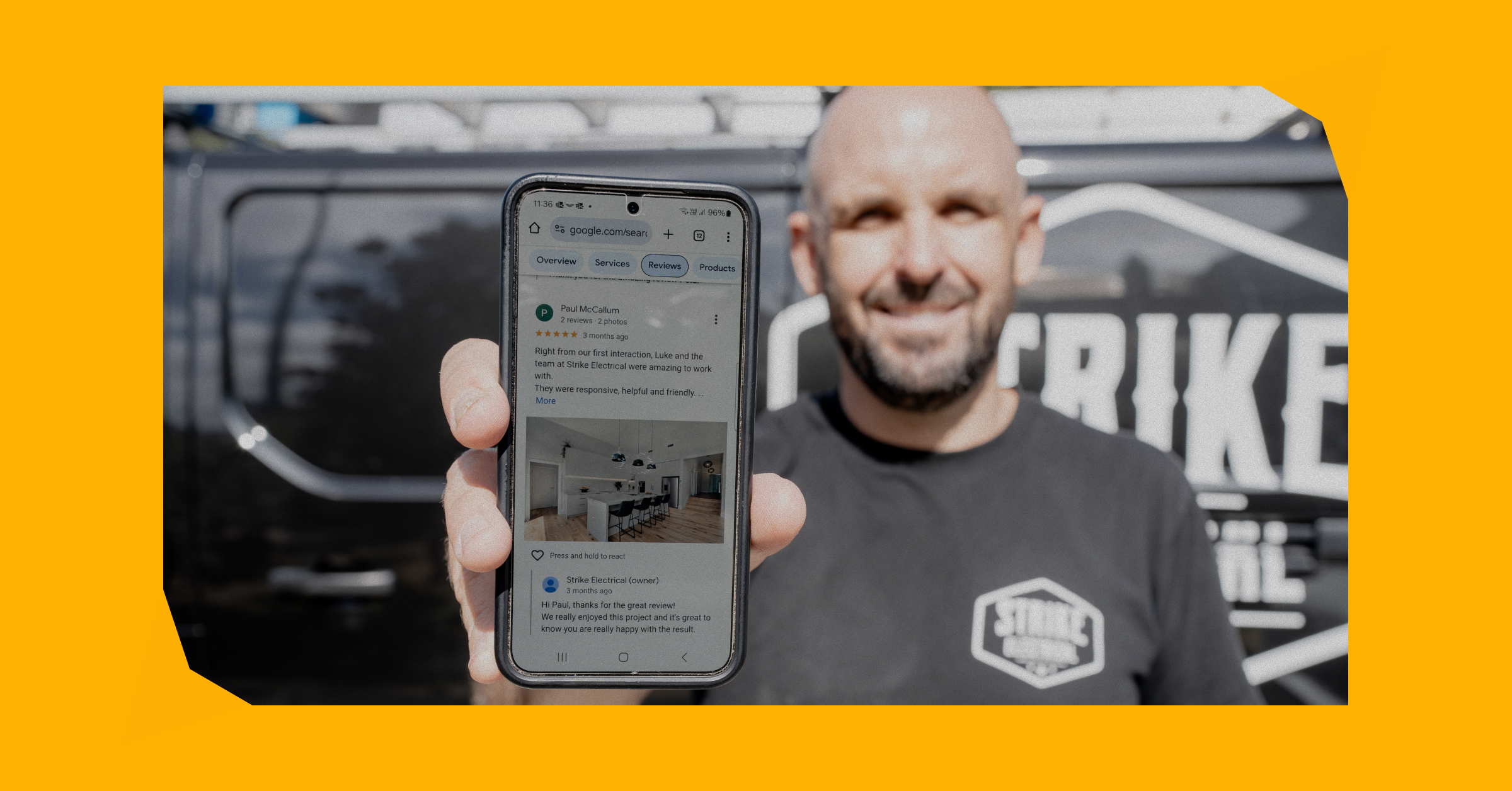
Google confirms that review quantity, content and positive ratings can help with local prominence — essentially, how well-known and trusted your business appears to be in its local area.
Prominence is one of the factors it uses when deciding which businesses to show in local search, which is why reviews are important.
But there’s more value in a good review than just the star rating.
Consider these two reviews:
“Great service. Highly recommend.”
and:
“The team replaced our old switchboard and installed an EV charger at our home in Cambridge. Communication was great and everything was left really tidy.”
Both are positive. But the second one tells a much richer story.
It talks about:
- the services provided
- the type of customer
- the location
- the experience
- what the business did well
That doesn’t mean you should tell customers what keywords to write.
Please don’t.
Let customers describe the experience in their own words.
Ask for genuine feedback shortly after the job has finished, while the experience is still fresh in the customer’s mind. The details of your work will be easier to recall, which usually leads to a more thorough and useful review.
Over time, those real customer stories create a strong picture of what your business is actually known for.
4. Other credible places around the web
Your own website and Google profile aren’t the only places Google looks.
Google says business information can come from publicly available web content, licensed third-party data, user contributions and other sources.
That might include places like:
- supplier or partner websites
- local business directories
- news articles
- community organisations
You don’t need to spend every Friday afternoon submitting your company to 400 random directories. That’s exactly the kind of SEO rabbit hole we’re trying to avoid.
The more useful question is:
Are there legitimate places online where people would reasonably expect to find information about our business?
If you’re a Registered Master Builder, for example, it makes sense for your information there to be correct.
If your local chamber of commerce has an old phone number listed, update it.
If a supplier has a “find an installer” page and you’re an approved installer, being listed there could be useful for customers as well as giving search systems another credible reference point.
Think real-world credibility first.
Not link-building tricks.
5. Is Google seeing the current version of your business?
This one gets overlooked.
Businesses change.
You move premises, hire more staff, stop offering one service and start offering another. Your phone number changes, hours change, and you expand into a new area, but bits of the old business can hang around online for years.
Now you’ve got:
Website: Open Monday–Friday
Google: Open Saturday
Old directory: Closed Monday
Facebook page from 2019: Different phone number
That’s not ideal for customers, and it doesn’t create a particularly clear picture for Google either.
Google specifically recommends keeping Business Profile information accurate, complete and up to date.
You don’t need every comma on the internet to match perfectly, but important facts should be right.
Pay particular attention to:
- business name
- address
- phone number
- opening hours
- service area
- website address
- key services
When something important changes, update the places people (and search systems) are most likely to rely on.
Don’t disappear down the SEO rabbit hole
There’s an endless supply of advice online about local rankings.
Add this keyword, rename that photo, geotag these images, create 50 directory listings, post at exactly 2:37 pm every Tuesday.
Some advice may have a sensible reason behind it, but plenty of it is speculation, outdated advice or a tiny tactic dressed up like the secret to Google.
Google is very clear that there is no way to request or pay for a better local ranking. It says local results are mainly based on relevance, distance and prominence:
- Relevance: how closely your business matches what someone is searching for.
- Distance: how close your business is to the person searching, or to the location they’ve included in their search.
- Prominence: how well-known or established your business appears to be, based on signals like reviews, links and other information about your business online.
So before worrying about clever tricks, get the obvious things right.
Can Google work out what business you are?
Can it understand the main services you provide?
Is your location or service area clear?
Does the information appear current?
Are real customers regularly adding genuine evidence about their experience?
Can Google find credible information about your business elsewhere online?
Those fundamentals are a lot more useful than chasing whichever “local SEO hack” appeared on LinkedIn this week.
Try the “What does Google see?” audit
You can do this yourself in 15 minutes.
Open an incognito or private browser window and pretend you’ve never heard of your business.
Then work through these five checks.
1. Search your business name
From the results, can you quickly work out:
- what the business does?
- where it operates?
- how to contact it?
- whether it appears active?
- whether the information looks current?
Write down anything that is wrong, unclear or missing.
2. Open your Google Business Profile
Check:
- business name
- primary category
- secondary categories
- services
- products
- phone number
- website
- hours
- address and service area
- business description
Ask yourself, does this still describe the business we are today?
3. Read your website like a stranger
Don’t read it like the person who built it. Imagine you’ve just landed there from Google.
Within a minute, can you tell:
- who the business is?
- what its main services are?
- where it operates?
- how to get in touch?
If something important exists only in your head, add it to the website.
4. Read your last 10 reviews
Forget the star rating for a second. What would someone learn about your business from the words customers are using?
Are customers mentioning the services you want to be known for? Are there repeated themes around reliability, communication, workmanship or other strengths?
You’re looking for the story your customers are telling about you.
5. Search your business name + location
Try something like:
“Smith Plumbing Hamilton”
Look beyond your own website.
What else appears?
Check the credible results and make sure important information isn’t outdated, then fix the biggest gaps first.
You don’t need to spend three weeks “optimising your citations”.
You’re simply making sure the important evidence around your business tells the right story.
Final thought
Google can’t walk onto a job site and see how good your team is.It can’t watch you solve a tricky problem or see the customer shake your hand at the end and say, “Thanks, that was brilliant.”
It has to rely on the evidence available to it.
Your job is to make that evidence clear.
Keep your business information accurate, explain what you actually do, make your service area obvious, build a steady stream of genuine customer reviews and keep important information current wherever people are likely to find you.
You don’t need to convince Google that you’re something you’re not.
You just need to make it easier for Google to understand the good business that’s already there.

Get a free reputation audit
Schedule a 1:1 call today and discover how to win on trust.

Success!
When it happens next? Based on what we find, one of the team will either give you a quick shout to walk you through the plan, or we'll just email the full advice pack straight over to you.
Either way, we'll make sure you get the best bits of advice to start winning on trust straight away.
Articles you might like

Missing Google Reviews? Here's what to do
Seeing genuine Google reviews disappear is stressful, and it can have a real impact on your business.
Read
Struggling to rank in Google Search? Here's how to fix that!
If you're a small business owner, you've probably spent a fair amount of time building and maintaining your website. But despite all your efforts, you might notice that it’s not ranking as high in ...
Read
Google reviews: Your key to winning more customers in 2025
In today’s digital world, Google reviews have become more important than ever for businesses like yours. As we move into 2025, they’re not just nice to have—they’re essential. Whether you’re a local ...
Read.png?width=768&height=591&name=TeamBrainstorm_Blue%20(1).png)
Get your trust wins.
We’ll take a proper look at your Google profile and send a short video with 3 simple fixes you can apply straight away to strengthen your local reputation. No sales pitch — just clear, practical advice.
Where should we send your video?
Share your details below and we’ll get started. You’ll hear back within 2 business days. No spam, no pushy follow-ups.

All set — we’re onto it.
One of the team will email you within two business days to confirm we’ve got the right business.
Once that’s confirmed, we’ll record and send your personalised video with clear, practical fixes to help you win more trust straight away.