.png?width=120&height=121&name=CustomerHappy_V2%20(4).png)


The way people search for local businesses is changing.
Customers are not always going to Google, typing “plumber near me” and choosing one of the first businesses on the list. Increasingly, they are asking AI-powered tools more specific questions, such as:
“Who is the best plumber near me to help with a hot water cylinder?”
“Which electrician installs EV chargers and has good reviews?”
“Can you recommend a painter who is experienced with older villas?”
Tools like ChatGPT, Google AI and other AI-powered search platforms are designed to understand these detailed questions and recommend businesses that appear to be a strong match.
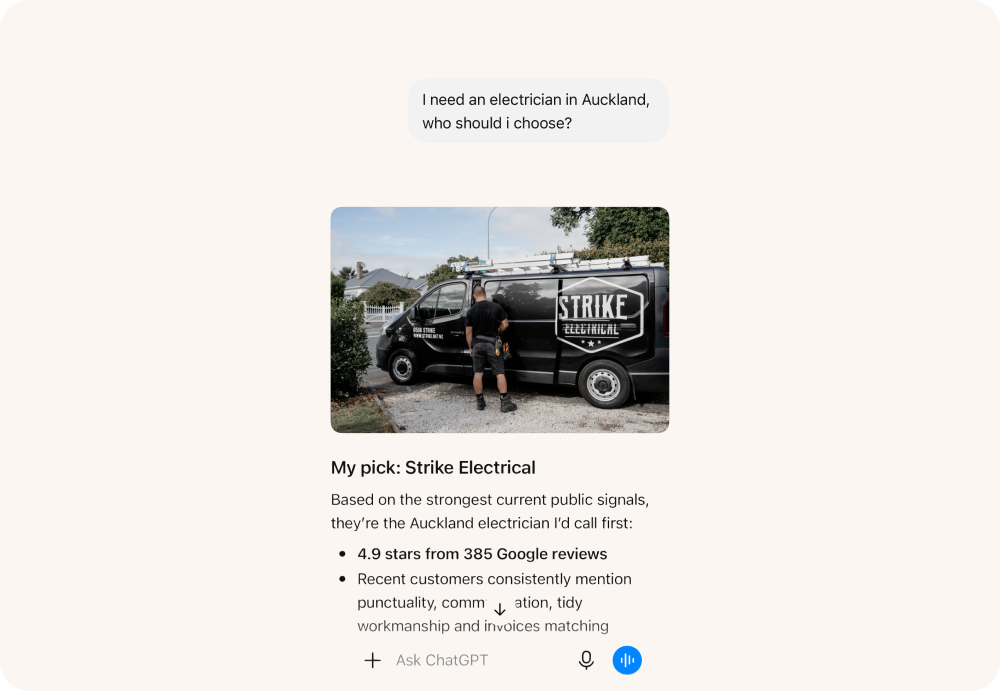
To do that, they need to understand what your business does, where you work, what you are known for and whether customers trust you.
The good news is that there are practical things you can do to make your business easier for AI to understand—and increase your chances of appearing in these search results.
It does not need to be complicated or expensive.
Here are the three best places to start.
1. Keep your business information consistent across the web
Your business information is scattered across more places than you might realise.
It could appear on:
- your website
- your Google Business Profile
- online directories
- industry websites
- old social media accounts
- supplier or association websites
Search platforms use information from these sources to build an understanding of your business.
If the details are inconsistent, that understanding becomes less reliable.
One website might show your old address. Another might display your landline, and another uses a mobile number. Your Google Business Profile might use a slightly different business name from your website.
Even small inconsistencies can create unnecessary confusion.
A good place to start is with your NAP information:
- Name
- Address
- Phone number
Your core business details should be accurate and written consistently everywhere they appear.
For example, avoid using:
“Smith Electrical Ltd” on your website
“Smith Electrical Services” on Google
“Smith Electrical Hamilton” on Facebook
Unless these are genuinely different businesses or locations, choose the correct business name and use it consistently.
You should also check that your:
- website address is correct
- opening hours are current
- business descriptions are up to date
- duplicate listings have been removed or merged
- old addresses have been updated
- phone numbers match
Think of this as cleaning up your business’s digital footprint.
Clear, consistent information gives Google and other search platforms more confidence that they have correctly understood who you are, where you operate and how customers can contact you.
2. Build a steady flow of detailed customer reviews
Reviews have always helped customers decide which business to choose, but in the AI era, those reviews have become even more valuable.
That is because reviews contain real customer stories.
Your website might say you are an electrician, but your reviews could mention:
- switchboard upgrades
- EV charger installations
- emergency callouts
- rental maintenance
- heat pump wiring
- tidy workmanship
- fast communication
Together, those stories create a much clearer picture of your business.
Those real customer reviews help AI search platforms understand the specific services you are known for, the problems you solve and the type of experience customers have when working with you.
The same applies to almost every local business.
A doctor's reviews might mention short wait times, children’s check-ups or emergency appointments.
A building inspector's reviews might mention attention to detail, competitive pricing, and fast turn-around times.
That detail makes it easier for AI search platforms to connect a specific customer question with a relevant business.
The words matter, not just the stars
This review is positive:
“Great job.”
But this review provides far more useful information:
“They repaired our leaking hot water cylinder the same afternoon, clearly explained what had gone wrong and left the laundry spotless.”
It describes:
- the service completed
- the problem solved
- how quickly the business responded
- the customer experience
- the final outcome
This doesn't mean asking customers to include particular keywords or telling them what to write. Reviews should always be genuine and written in the customer’s own words.
Your job is simply to make it easy for customers to share their experience while it is still fresh.
Consistency is more valuable than the occasional burst
Frequency matters too.
AI-powered search platforms are not just looking at how many reviews a business has. They are also looking for signs that the business is active, relevant and still delivering a consistent customer experience.
A profile with hundreds of reviews but nothing new for nine months gives AI less current information to work with.
A steady flow of recent reviews creates a much clearer signal.
It shows that the business is still operating, still serving customers and still being talked about in a positive and relevant way.
The best approach is to build review invitations into your normal process.
Send them every week.
Ask soon after the work is completed.
Use email, SMS, or QR codes to make it easy.
The goal is not to flood your profile overnight. It is to create an ongoing stream of genuine customer stories that gives AI fresh, reliable evidence about the work your business is doing now.
3. Keep your Google Business Profile up-to-date
Your Google Business Profile is one of the clearest sources of information AI search engines use to understand what your business offers.
If your profile is vague, outdated or incomplete, AI has less reliable information to work with. The more accurately your profile reflects your real services, the easier it becomes for AI-powered search platforms to recognise when your business is a good match for someone’s question.
Update your categories, services and products
Start by checking that your primary business category reflects the main service you provide.
Then, add relevant secondary categories to cover other important parts of your business.
Next, review your services and products.
Avoid broad descriptions like “electrical services” or “painting” when you can be more specific. List the actual work you complete and want to be found for.
For example, an electrician might include:
- EV charger installation
- switchboard upgrades
- heat pump wiring
- emergency callouts
- rental property maintenance
- lighting installation
The products section can also be useful for highlighting key services, packages or areas of expertise, even if you don't sell physical products.
For example, you might create product listings for EV charger installations, house washing packages, dental check-ups or kitchen renovation consultations.
The goal is to give AI search engines clear, specific information about what you do, rather than expecting them to work it out from a short business description.
Post regularly using real, high-quality photos
Your profile should also show that your business is active.
Regular posts give AI search engines more current information about the work you are completing, the services you're promoting and the areas you operate in.
You could share:
- recently completed projects
- before-and-after results
- seasonal advice
- common customer questions
- new services
- team updates
- awards or qualifications
- behind-the-scenes activity
Keep the posts simple and useful. A high-quality photo from a recent job with a few sentences explaining what was completed, where it took place and what problem was solved can provide valuable context.
Use real photos of your business wherever possible.
Show your team, vehicles, premises, equipment, completed work and people working on-site. These images provide genuine evidence that your business is real, active and completing the services you claim to offer.
AI-generated images may look polished, but they do not provide the same proof. They can also make your profile feel generic or disconnected from the real business behind it.
Your categories, services, products, posts and photos should all support the same story.
If your profile says you install EV chargers, your services should list EV charger installation, your posts should show recent installations, your photos should feature the real work, and your reviews should describe customers’ experiences.
When all of those signals line up, AI search engines have a much clearer understanding of what your business does and when it should be recommended.
What this means for your small business
You don't need to completely reinvent your marketing strategy.
Start by strengthening the information that already exists.
Make sure your business details are accurate everywhere, build a regular system for collecting genuine customer reviews, keep your Google Business Profile up-to-date, and post consistently, showing real photos of your people and work.
None of these steps are complicated SEO hacks. They are simply good ways to present your business online.
AI search platforms are becoming better at connecting information from different places. The clearer and more trustworthy that information is, the easier it becomes for them to understand when your business might be a good match.
AI-powered search is trying to provide useful answers, not simply display the websites that repeat a keyword most often.
How Betterbunch helps
Keeping your online reputation healthy can be difficult when you are also trying to run a business.
Review invitations get forgotten.
Google Business Profile information becomes outdated.
Old directory listings remain online.
Weeks pass without anyone posting new photos or updates.
Betterbunch helps small businesses turn those jobs into a consistent process.
Our Better Reviews system helps you ask for feedback by email or SMS, so you can build a steady stream of genuine customer stories without awkward request and time-wasting.
Our Better Listings service helps improve and maintain the information customers find about your business online.
The goal is to make your business easier to find, easier to understand and easier to trust—by people and the search platforms helping them make decisions.
Final thoughts
The AI era does not mean everything you know about local marketing is suddenly irrelevant, it just means the fundamentals need to be stronger.
Your business information needs to be accurate.
Your customers’ experiences need to be visible.
And your Google Business Profile needs to clearly explain what you do.
Start with these three areas:
- Keep your business details consistent across the web.
- Build a steady flow of detailed customer reviews.
- Clearly show what you do with updated services, relevant posts and real photos.
Do those things well and you will not just be preparing for AI search.
You will also be creating a clearer and more trustworthy online presence for every potential customer who finds you.


Get a free reputation audit
Schedule a 1:1 call today and discover how to win on trust.

Articles you might like

Google Reviews in the AI Era
If you’re a local business owner, you’ve probably heard plenty of SEO advice over the years. Add more keywords. Write more blogs. Optimise your website. Update your Google Business Profile. And yes, ...
Read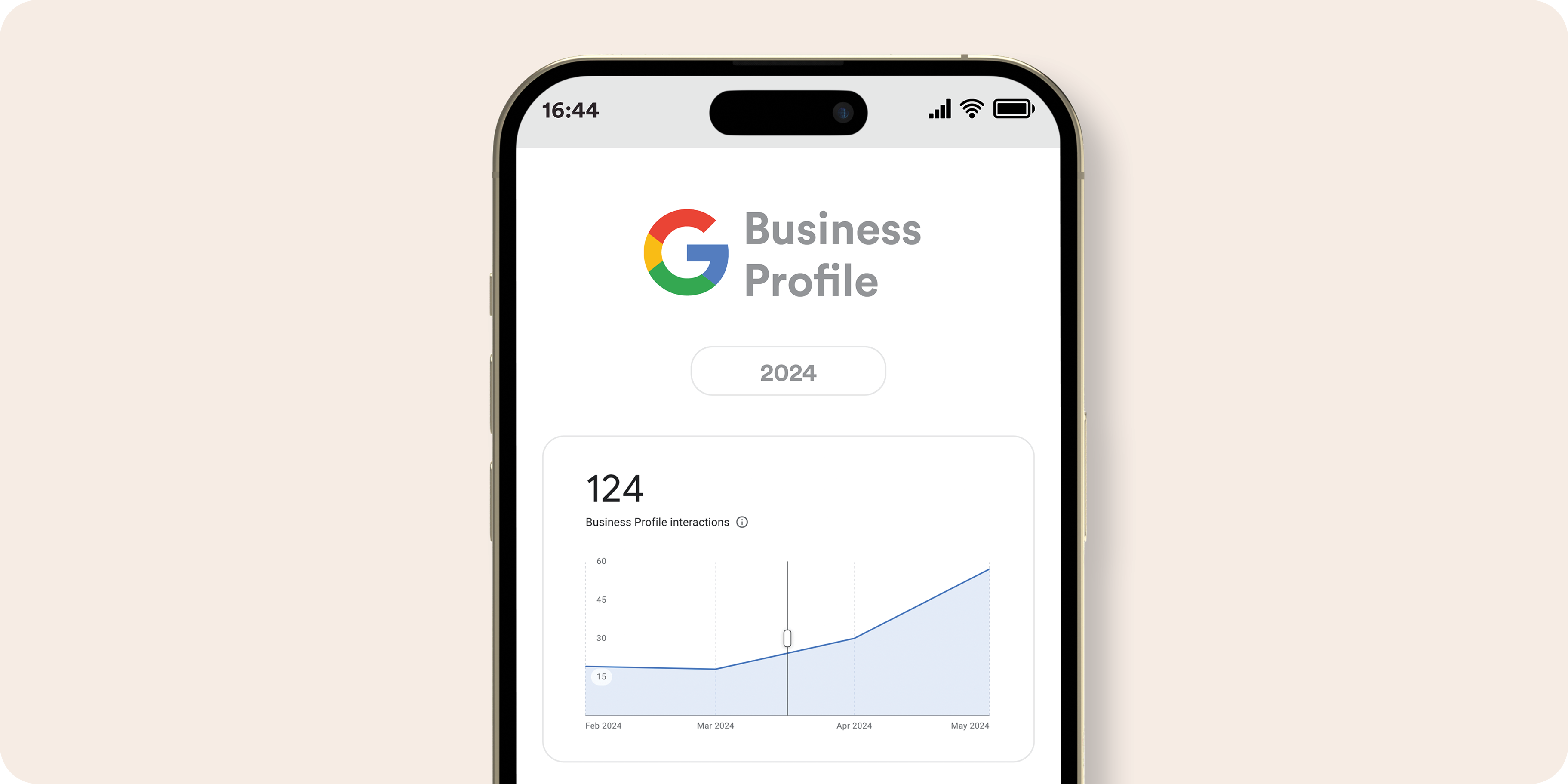
Understanding how to leverage Google Business Profile Analytics
One of the most effective ways to increase your business's online visibility is by maintaining a Google Business Profile that establishes your brand authority. This profile allows potential customers ...
Read
Free keyword research tools: An essential for your small business
As a small business owner, you know getting noticed online is essential. But how do you show up when someone searches for services like yours on Google? The answer is simpler than you think: ...
Read.png?width=768&height=591&name=TeamBrainstorm_Blue%20(1).png)